

Designing the spaces where people engage
An engagement space is a space in which actors engage and resolve that engagement into an action — and where a decision not to act is an action too. It exists wherever decisions are made with people rather than computed at them: cities and their residents, institutions and their members, platforms and their participants, organisations and their teams.
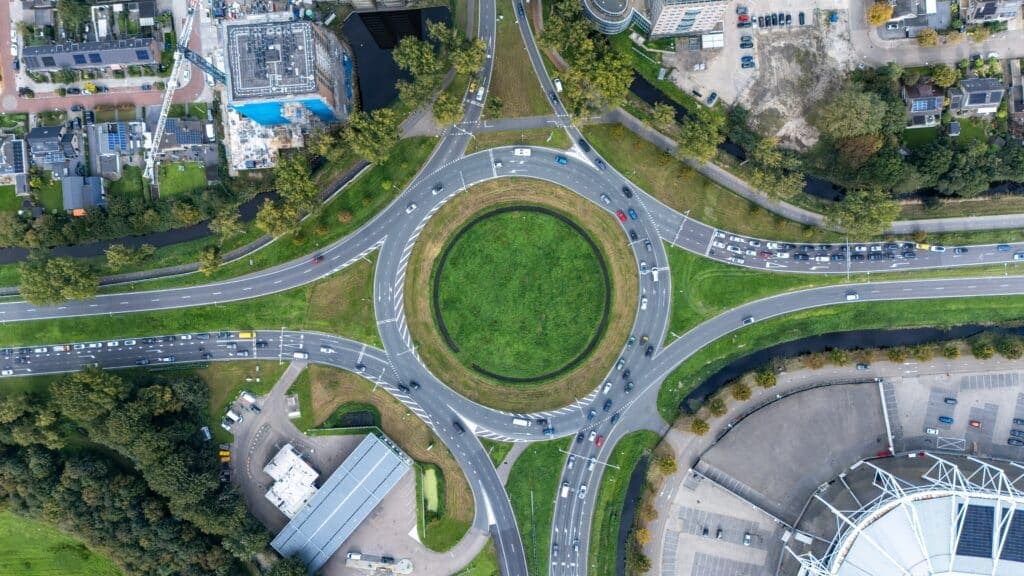
Engagement spaces are an attractive alternative to model-based hierarchical steering mechanisms, for organizing collective action in complex systems. For instance to govern a natural resource as a commons, or to organize a shared task, or to collectively use a limited and relatively inflexible resource (such as infrastructure roads, charging, locks, docks, or facilities like hospitals ). A roundabout is popular example of an engagement space, as an alternative to intersections with traffic lights.
Most existing engagement spaces have been created by accident, based on intuition. A more formal methodological approach accelerates the successful design and introduction of an engagement space for a specific use case. This website introduces experts and practitioners to the theory, taxonomy and (emerging) methodology of the design of engagement spaces.
This site is about how to create them deliberately: how to define them, design them, test them, evaluate them, bring them live — and keep them healthy for as long as they serve.
The core idea: an option space with boundaries
At the heart of every engagement space lies the option space — the set of choices actors may freely make, bounded by design. Three ideas define it:
- Actors decide locally. People weigh options, take decisions and bear the consequences, as they see fit — their local judgment is a feature, not a defect.
- Boundaries make freedom safe. The boundaries limit the option space, so actors can act confidently because they know exactly where their freedom ends.
- Rules of engagement are a protocol. Just as communication protocols let systems interact without renegotiating the basics, rules of engagement reduce the cognitive load of engaging — participants decide what to do, never how again.
This is what separates an engagement space from an algorithmic optimisation approach. Because behaviour emerges from countless local decisions, an engagement space cannot be modelled and computed like software. It must be built with humans, tested with humans, and kept alive by humans.
The methodology: a cycle, not a checklist
Definition
Before any design: benefits that justify the cost, scope and boundaries, and the process hierarchy that owns it all.
Design
Identify the events that trigger engagement, define the option space and rules of engagement, and integrate them into an integral design.
Simulate
Observe the emergent behaviour you cannot compute — through serious games that hunt for rule-gaming and force a complexity verdict.
Evaluate
Ask whether the benefits are realised, the effort is proportional, fairness is provable — and feed the answers into a new design cycle.
Going Live
Stage reality in monitored phases; manage expectations openly, because not everything can be foreseen.
Monitor
Keep the space healthy in a moving world — societal change, new technology, passed scale thresholds — anchored in the process hierarchy.
Built for real humans
Every chapter of this methodology assumes the same thing about participants: they are creative, goal-seeking and stubborn. Rather than fighting that, the methodology uses it:
- Stakeholders hunt for exploits in serious games, so loopholes surface before consequences are real.
- designs get complexity verdicts from the people who must navigate them, with IT support carrying the heavy lifting.
- Escapes for edge cases return hard problems to humans around a table — where they belong.
- Living informal practice is respected, never steamrolled into formal overhead.
- Low thresholds to start and to leave keep participation voluntary — the only kind an engagement space can legitimately ask for.
- An active feedback loop from complaining users to governance bodies turns every participant into a sensor.
Two disciplines hold it all together: a clear process hierarchy — design authority, operating authority, actors — that gives every insight an owner, and proof of fairness as a constant requirement, not an afterthought.
Who this is for
- Sponsoring institutions deciding whether an engagement space is worth the cost — and what benefits to demand in return.
- Design authorities drawing up blueprints, option spaces and rules of engagement.
- Operating authorities creating, maintaining and staging live instances.
- Participants and facilitators who want to understand the space they are part of — and how their feedback shapes it.
Start here
- New to the concept? Begin with the Introduction to the methodology.
- Ready to build? Start at the beginning: Definition — because conditions and boundaries come before any design.
- Already live? Jump straight to Monitor and bring the cycle back to work.
An engagement space turns disagreement, hesitation and negotiation from friction into a designable resource — a space where engagement resolves into action, and everyone can see the state they helped create.
Use Case Examples
 Carriers exchanging their DC loading and unloading slot times among themselves
 Inland vessels negotiating their order at a lock.
 Shared mobility users contributing to fleet rebalancing
 Street residents collectively regulating transportation movements in their street
 A workforce collectively making and updating their own workforce planning